Collier Farms Performance Bull Sale 2017
5
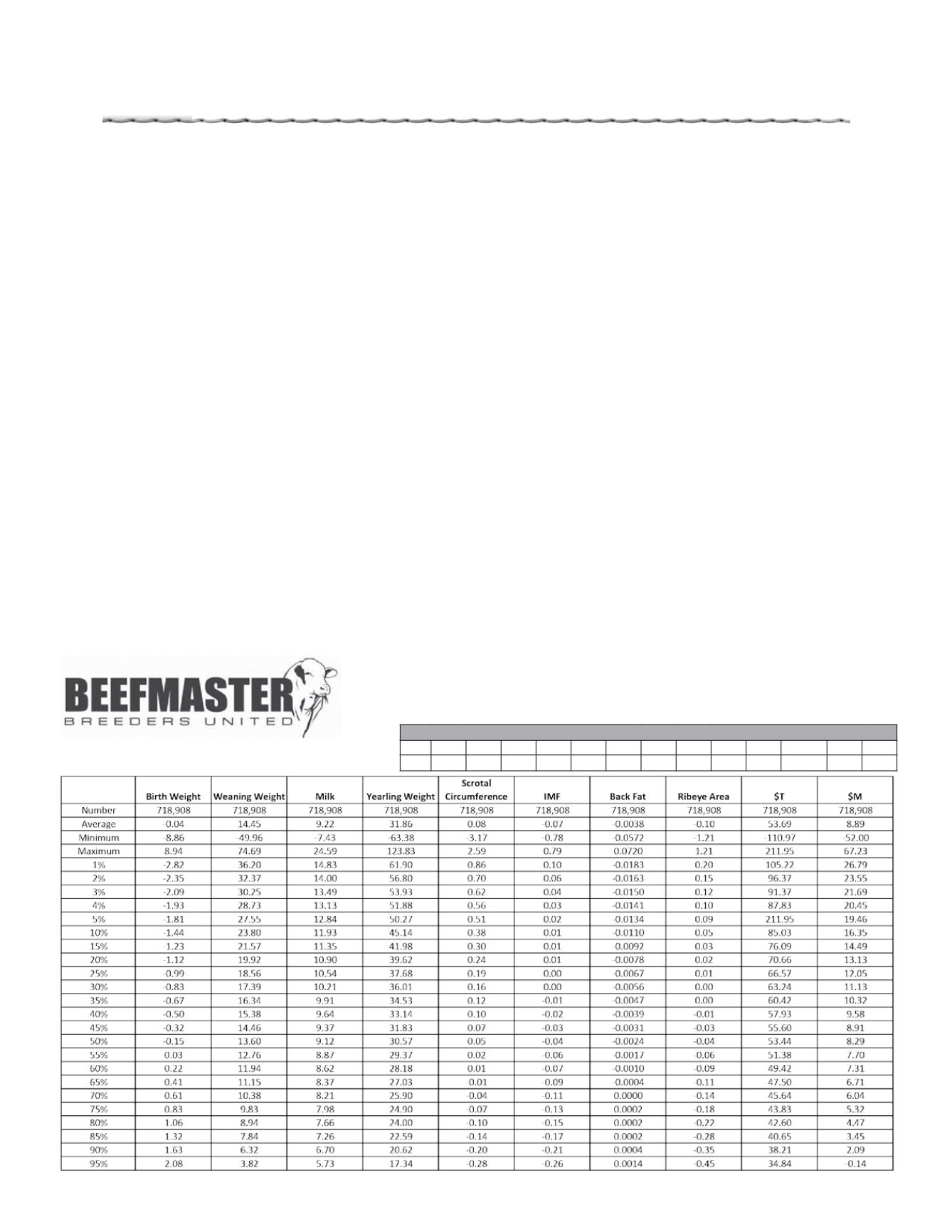
New to this year’s Collier Farms Performance Bull Sale catalog are BBU’s first
$value indicies in the EPD box. These selection indices are expressed as $T
and $M will help cattlemen make a more well rounded decision when making
their bull purchasing selections.
Selection Indices combine traditional expected progeny differences (EPDs)
with economic values to give a more complete view into how an animal’s
progeny performance will impact the bottom line of an operation. Since EPDs
have been implemented, they have been used to make both wise and unwise
selection decisions because many ranchers tend to “single trait select”for traits
that are perceived to have greater value.
An example of this would be picking bulls with high YearlingWeight (YW)
EPDs for the purpose of increasing the finish weight of steers coming out of
the feedyard. True, you will significantly increase the pay weight of the steers
but the unintended consequences of this decision is that the rancher has also
increased the mature weight of the heifer mates to the steers. This increased
mature cow size leads to a greater feed costs in the cow herd, increased cow
maintenance costs and possibly decreased conception rates, if the cow’s
nutritional needs are not met.
By using the appropriate selection index, ranchers can avoid single trait selec-
tion and more accurately improve the trait(s) that impact his profitability. To
get the most out of indices, it is important for the rancher to know his scenario
and select animals that best fit those production parameters.
Terminal Index ($T)
$T or Terminal Index is designed for the retained ownership cattleman, feeder
cattle buyer or packer who is most interested in fast growing, high performing
steers, who will be sold to the packer on grids based on carcass merit. $T is
a combination of WW, YW, REA and IMF EPDs. These traits accurately tell us
about the growth and carcass merit of that animal. When these are combined
with historical Choice/Select and Yield Grade pricing components, they give a
very accurate description of the future value of a bull’s steer progeny. While the
individual EPDs describe certain traits very well, the index does a better job of
selecting for all of these traits at the same time.
Maternal Index ($M)
$M or Maternal Index is designed to help ranchers select animals that fit into
a maternal criteria. Dr. Matt Spangler of the University of Nebraska describes
$M as the $ profit per cow exposed due to calf weaning weight accounting for
costs associated with cow maintenance. Unique in the industry, $M accounts
for growth, milk production and fertility and considers expected cow mainte-
nance issues to arrive at an economic figure that is meaningful to the cowman.
The EPDs considered and factored into $M areWW, YW, Milk and SC. These are
balanced against cow maintenance costs as a result of mature cow size and
milk production.
It is important for users of these BBU Indices to understand the assumptions
for $T and $M and use them accordingly. If a buyer is interested in only growth
and carcass merit and is not planning on keeping replacement heifers, then
$T is a great tool that will add to the rancher’s revenue generating power from
the sale of steers to the packer.
Conversely, if the rancher is selecting bulls to produce replacement females
where their progeny will be sold at weaning, and the ultimate long term
goal of making a profitable cow herd focused on balancing growth, milk and
fertility with cow costs, then $M will be a valuable guide in identifying those
genetics.
If you have questions please contact the BBU office for more information at
210-732-3132 or
.
N
ew
B
eefmaster
$
V
alues
I
ndices
BREED AVERAGE FOR FALL 2015 BORN CALVES
CEM BW WW YW MILK TM MCE SC REA %IMF RIB FAT $T $M
EPD
2.8 0.5 23
41
9
20 3.1 0.3 0.16 0.0 -0.03 69.95 14.83
Beefmaster Percentiles as a Whole Breed


